
In this guide, we go through several different types of dyeing leather, ranging from covering small, strong tears in the leather, to completely repainting a pair of shoes or a bag. Different types of leather dyeing require different types of techniques and different products, here is a good overview.
We will go through the following different types of dyeing of leather in this guide:
– Cover a tear in the leather
– Cover minor marks and regain color on leather shoes
– Cover marks and regain color on leather products
– Cover minor marks and regain color on suede and nubuck
– Repaint ordinary leather
We mainly use products from the world-famous shoe and leather care brand Saphir . To find the right color, we recommend that you check out ours Sapphire color guide .
Covering a tear in the leather
A unfortunately not entirely unusual damage to both leather shoes and various leather products, such as bags, belts, wallets and so on, is that you happen to get a proper tear in the leather. As many leather products are made of chrome-tanned leather, its gray-blue core is visible, which makes the brand extra clear. The problem with this type of damage is not only that it can look dull, but also that the leather here becomes more sensitive, as it is not protected by the outer grain part which is most resistant.
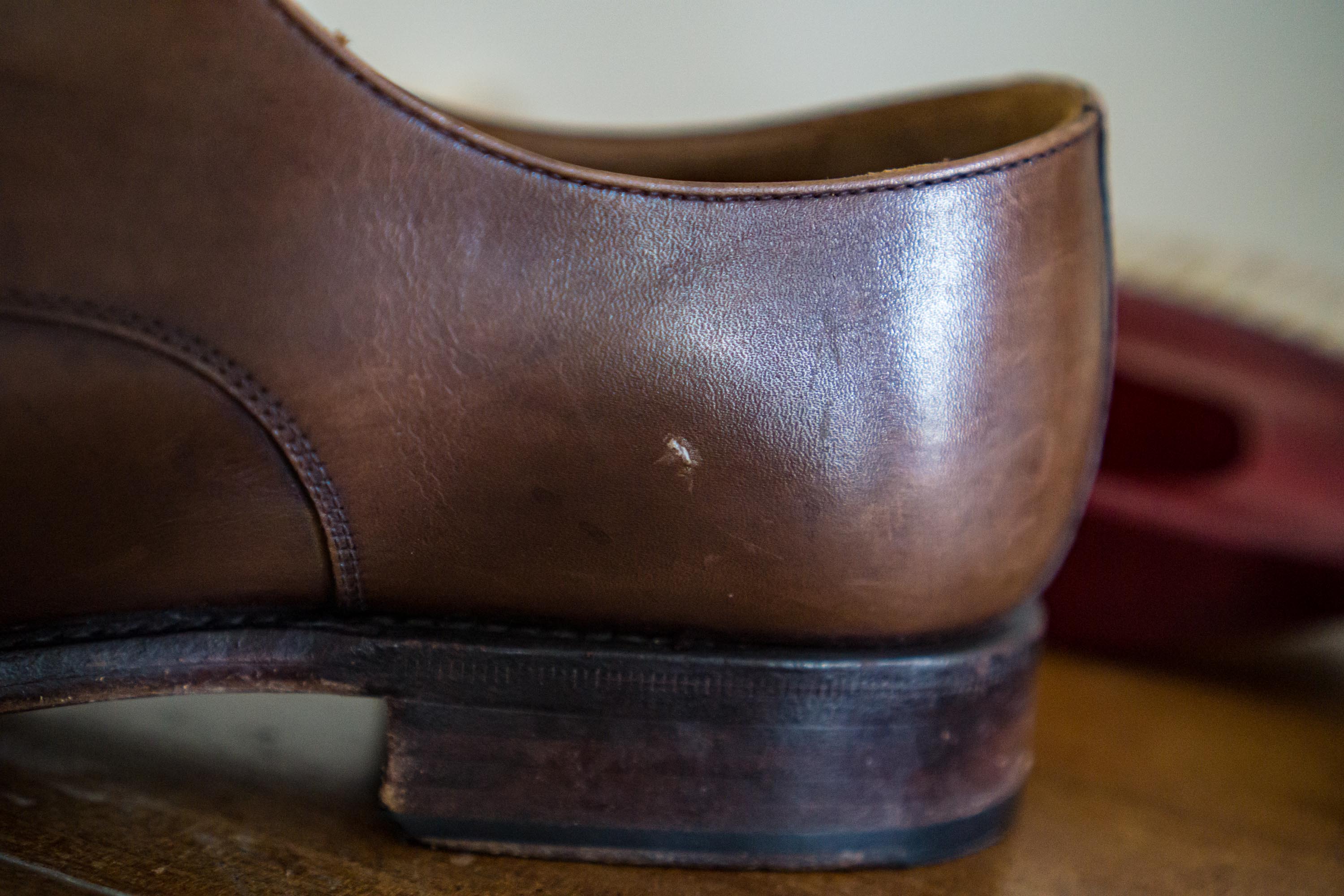
A tear in the leather of a shoe, where the light core is visible.
Sapphir Renovating Cream is a paste developed to cover this type of brand. Choose a shade as close to the color of the leather as possible, here it is extra important to match well as the paste itself should color over the brand, and ideally you should on leather that is not very close in shade mix different Renovating Cream colors to get as close as possible.
Make sure the area to be repaired is clean, and if loose pieces of skin protrude or are notched, try to level the tear as best you can. Take a very small amount of Saphir Renovating Cream on a plaster cloth (if the tear is small, you can fold the cloth to get like a small tip, on which you apply the cream), or use a finger. Try to get an even surface over the tear, and then wipe off excess around the tear immediately with a clean surface on the plaster. The repair should look as neat as possible, it is before the product dries that you have the opportunity to fix it and rather do it again and try again if it gets sticky or so. When you are happy with how you covered the tear, let it dry for 15 minutes, preferably half an hour. Check what it looks like, and improve if necessary, let it dry for 15-30 minutes again. Then you can easily sand up the surface with a clean part on the plaster cloth.

Shape the cloth to be able to apply a small dollop of cream just in the mark.

Clearly better afterwards. Seems smaller, and not least protected.
Cover minor marks and regain color on leather shoes
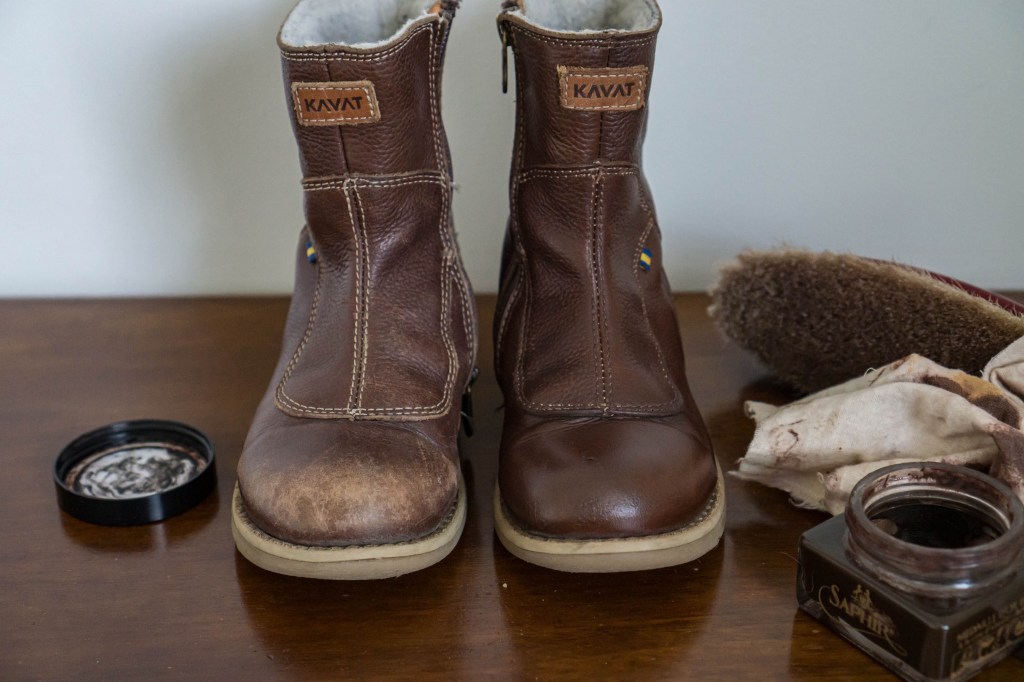
This is probably the part of this guide that is best known and most executed. That with a well-colored shoe polish you can cover over smaller brands and regain much of the color of leather shoes. We recommend Saphir Medaille d’Or Crème Pommadier, which contains a lot of pigment. It is also a shoe polish that is very expensive, so use small amounts and apply a thin layer over the shoe, either with a cleaning cloth or application brush. If it is striped shoes, also use the brush in the area between the upper and the sole edge, and do not forget the sole and heel edge itself, which is also made of leather and feels good from care and new color. If it is shoes that have a contrasting sole that you do not want to get color on, be sure to cover it with masking tape before if you want to be sure not to get color on it.

To really show what a difference pigmented shoe polish can make, we polish up a pair of very worn children’s shoes here. They have a sole edge in a light color, and it is covered with masking tape.
Let the shoe rest for 5-10 minutes and brush off excess and bring out the shine with a shoe brush with horsehair . If the shoes have a lot of marks, you can add 1-2 more layers according to the same procedure. If a higher gloss is desired, it is then advantageously supplemented with Saphir Pate de Luxe wax that gives the last shiny finish and additional protection.

Before and after.
Read more about how to polish your shoes and get in-depth tips in our shoecare guide . The shoe polish is very caring and adapted to give maximum care to heavily exposed shoes, however, it can discolour a little if it is used on leather products that are in contact with clothing, such as bags, belts or the like. To regain color on that type of product, we recommend Saphir Juvacuir recolouring cream (more about it below), it can also be used on shoes if you need another little color boost where the colored shoe cream is not enough.
Cover marks and regain color on leather products
Most leather products get marks and lose their color over time, but it is also possible to restore these so that they look fantastic again. Saphir Juvacuir recolouring cream is a pigmentation cream used to repaint skin products. Works great on all types of products in plain full grain leather or embossed leather such as shoes, briefcases, bags, jackets, wallets, furniture, saddles, belts and so on. It contains natural beeswax and other vegetable waxes to provide hydration and protection, but will not rub away or drop when wet.
Juvacuir is not used to change the color (because we have Saphir Teinture Francaise paint, more on that below), but to get back the paint on leather products that have become pale and dull or have had scratches or the like that caused it to drop. A bit of a miracle product, which can make really worn leather goods look like new again.
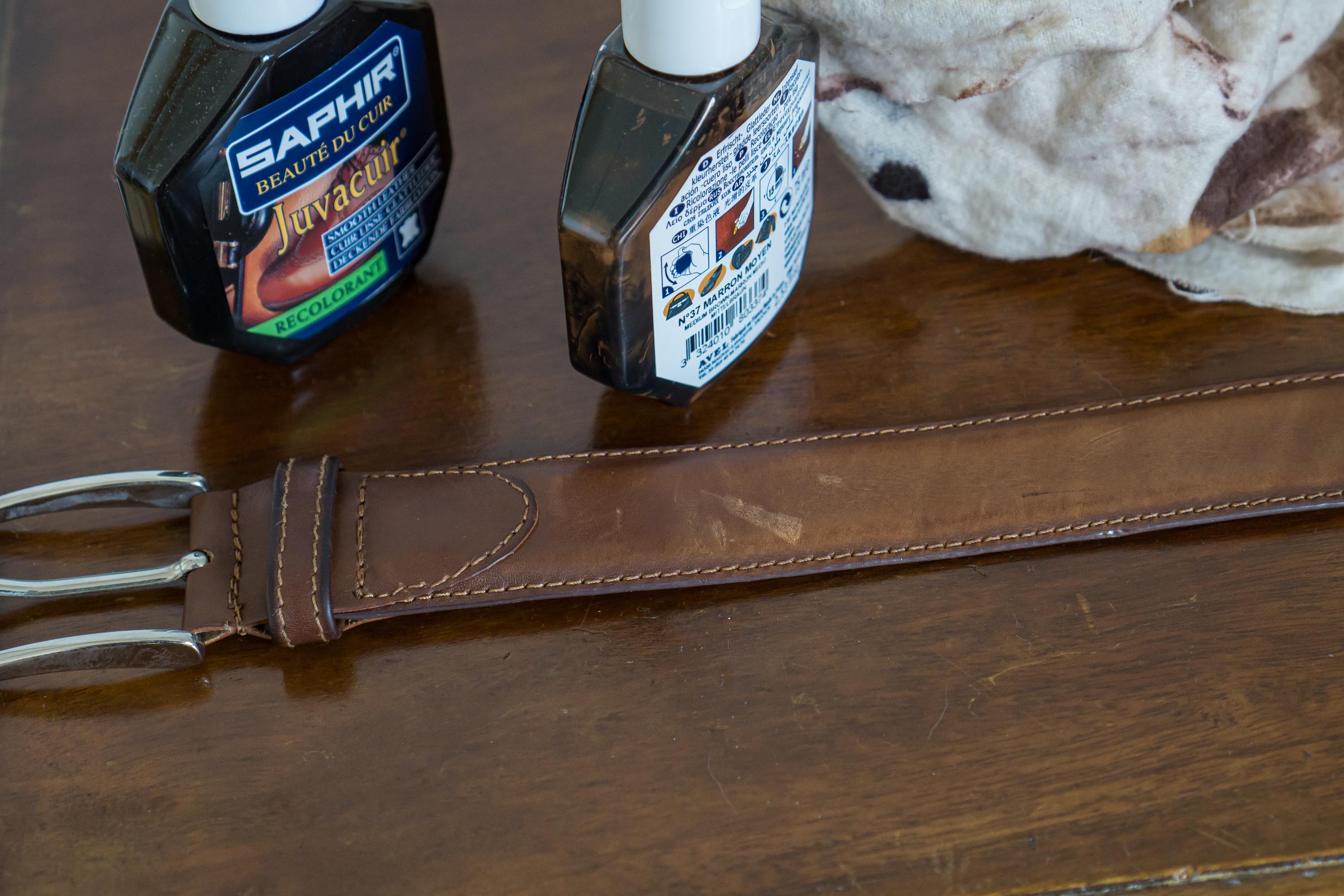
Belt that has lost some color and has some dull marks.
Before applying Saphir Juvacuir repainting cream, make sure that the leather is clean and has no dirt residue. It is best to use Saphir Renomat or Saphir Leather Cleanser . If the leather is dry, you may need to moisturize it before applying Juvacuir, otherwise it will not go into the leather. Moisturize with Saphir Leather Lotion or Saphir Dubbin Grease conditioner .
When applying Saphir Juvacuir, apply a small amount of cream to a damp cotton cloth and rub it gently in circular motions on the area you want to color. Let dry for about 15 minutes before covering it with a dry part of the cloth. Repeat if necessary. On leather products that are in contact with clothes and therefore can discolour, you can use Saphir Stop Color to be extra sure to avoid color drops .

Application of Juvacuir.

Like new again afterwards.
If these are shoes you have used it on, it is recommended that you use Saphir Medaille d’Or Crème Pommadier shoe polish and maybe also Saphir Pate de Lux wax polish afterwards (more on covering smaller marks and regaining the color of leather shoes above).
Cover smaller marks and regain color on suede and nubuck
Even for suede and nubuck, it is possible to repaint the material and cover dull marks. It is made with colored Saphir Medaille d’Or Suede Renovateur spray, which both cleans, cares for and repaint your suede or nubuck and makes it like new again, while they impregnate against moisture and dirt. The spray does not contain any silicone and is very concentrated and expensive.
It is best to spray with Saphir Medaille d’Or Renovateur spray when the shoes or leather products are reasonably clean. If they are really dirty, first wash them with a mild cleaner such as Saphir Omninettoyant and let them dry thoroughly. The suede is then brushed up with a good suede brush to lift the fibers again. If they are lightly soiled, just take the step with the suede brush and brush out the dirt with it.

Suede shoes before and after washing and spraying with colored Saphir Renovateur.
Then spray evenly over the entire shoe / suede product from a distance of about 20 centimeters. Mask / cover over surfaces that are not desired to be dyed / re-dyed so as not to risk staining, for example, the sole edge and other areas that are not the same color as the spray. Note that suede products should use only neutral, as pigmented spray can stain on garments etc. If the shoes are very worn at the toe, for example, you can spray a little extra there to cover with a new color. This is done outdoors. After 10-15 minutes, you can go over gently with the suede brush again, or a regular shoe brush with horsehair . For best protection against moisture and dirt, we recommend that you supplement with Saphir Medaille d’Or Super Invulner. If it is a leather product that comes in contact with and rubs clothing, such as a suede jacket or belt, you should use Saphir Stop Color afterwards, so that it does not discolour.
Repaint ordinary leather
For a more professional repainting of shoes or other leather products, a real leather color is used, such as Saphir Teinture Francaise. It is a so-called grain black, leather color, which penetrates the leather and attaches permanently, and which if you are skilled can be used to create a really delicious patina effect on the leather product, or just an even new shade. As a rule, it is only possible to repaint from a lighter shade to a darker one.

Shoes are repainted.
We have a detailed guide on how to paint shoes here, which you can follow even if you just want to change from one shade to another even shade, or for other leather products, with the only addition that you should use Saphir Stop Color afterwards.
 Koriumlab blog